Guide
Where does bathroom and sink drain odor come from, and how do you get rid of it?
Drain odor usually comes not from deep inside the pipes but from the strainer and drain opening right in front of you. The slimy layer that builds up there is one of the most stubborn sources of odor in the bathroom.
EcoProbiotic ·
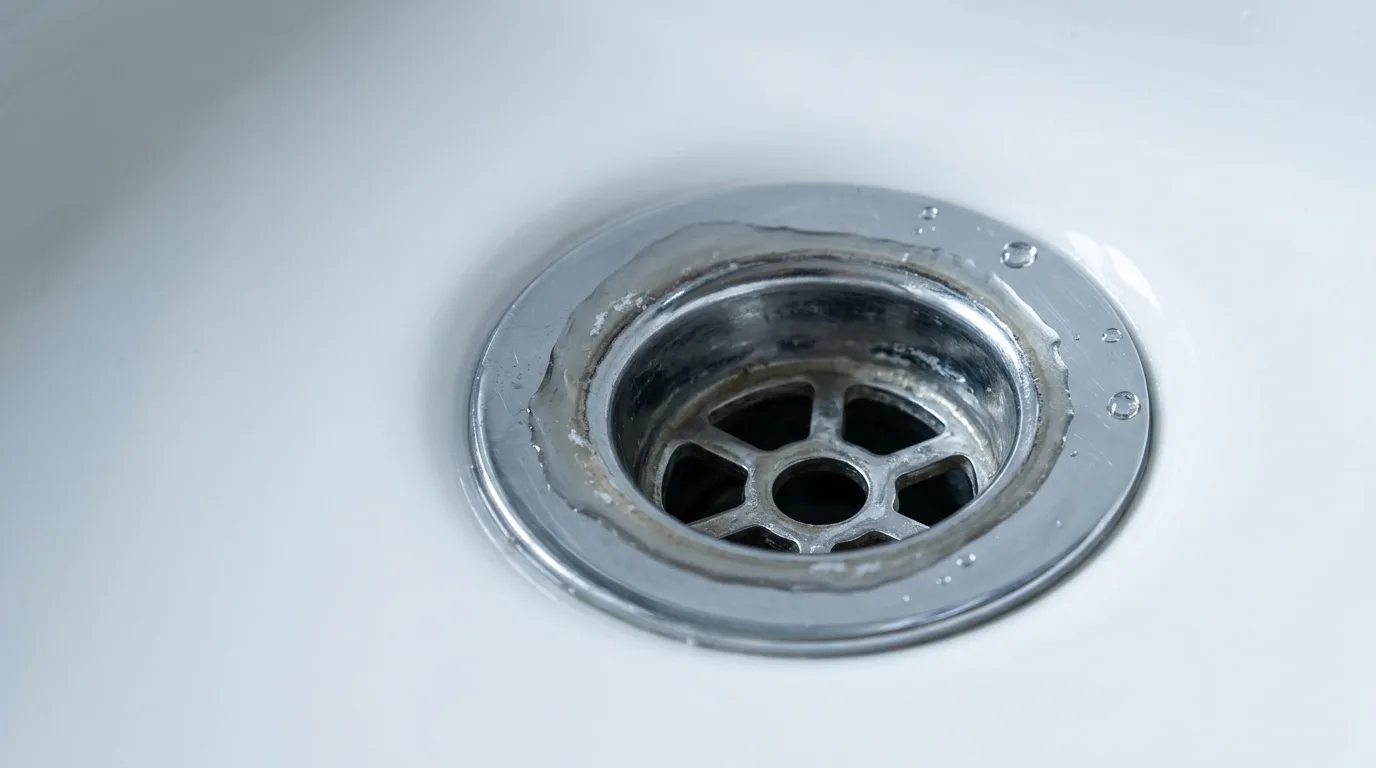
The slimy layer in the drain opening: biofilm
Samples taken from household sink drains contained a very dense and diverse community of microorganisms; this community also sustained itself in a laboratory model (McBain et al., 2003). Feeding on soap, shampoo, hair and skin residue, this layer is a major source of sulfur odors.
Biofilm climbs up to the strainer
In a study on sink setups, the biofilm climbed from the trap toward the strainer as long as it found nutrients; from there, splashing tap water scattered droplets into the surroundings (Kotay et al., 2017). That is why the drain opening and the area around the sink should be cleaned together.
Why doesn't a one-time harsh cleaning last?
In a study where a strong chemical foam was applied to hospital sink drains, the biofilm first dropped quickly but returned to its starting level within a few days (Bowie et al., 2026). Lasting freshness in the drain opening calls for regular care rather than a one-time harsh treatment.
How do you clean drain odor?
- Remove the strainer and take off any hair and residue.
- Spray the cleaner on the strainer and the inner wall of the drain opening, then scrub with a brush.
- Rinse with water after a few minutes.
- After the last use in the evening, spray the drain opening once or twice and leave it without rinsing.
- If the odor persists, have a plumber check whether the drain trap is holding water; a trap that doesn't hold water lets odor in from the plumbing.
How does a probiotic cleaner help?
A probiotic cleaner sprayed into the drain opening in the evening gives the probiotics the whole night to work on the residue. The probiotics consume the residue as food; with regular use, they help keep the drain opening fresh. The product contains no chlorine or acid and can be used on metal strainers and faucets.
Cleaning that goes to the source instead of masking the odor. View the product Free shipping within Türkiye
Sources
- McBain AJ, Bartolo RG, Catrenich CE, ve ark. Microbial characterization of biofilms in domestic drains and the establishment of stable biofilm microcosms. Applied and Environmental Microbiology. 2003;69(1):177–185. doi:10.1128/aem.69.1.177-185.2003
- Kotay S, Chai W, Guilford W, Barry K, Mathers AJ. Applied and Environmental Microbiology. 2017;83:e03327-16. doi:10.1128/aem.03327-16
- Bowie KR, Luhung I, Burke TR, ve ark. Nature Communications. 2026;17:6686. doi:10.1038/s41467-026-73533-y